
I can’t recall exactly when I met Kath after moving to Augusta in the early 1990s, but it was no doubt at an art event, as she was such an important part of the Augusta arts community. I had seen her fountain sculpture Cultural Triad on the campus of what was then Augusta College, but I remember seeing her paper pulp figurative sculptures for the first time and immediately being captivated by them.
I recognised how much aesthetic overlap there was with my own sculptural work. Kath and I both carved wood and cast bronze, but the strongest connection was a shared love of natural materials and textures. Because of this affinity, we exhibited together on three different occasions. One of those shows was at the Mary Pauline Gallery in Augusta in 2002, titled Mother Nature, and it featured some of the pieces included in this current exhibition.
With this showing at Candl Fine Art, I am again struck by the tactile surfaces and detail of her work. There is such a continuity in form and subject. Kath often spoke of her many travels and how she loved to bring back stones, shells and other natural elements to incorporate into her pieces. She also mentioned her fascination with Cycladic (ancient Greek) sculpture and its abstract human forms.
All of these influences are evident in the sculptures presented. The works are totemic, timeless and deeply engaging. Every time I see Kath’s sculptures, I see them as her artistic celebration of both nature and the human form.
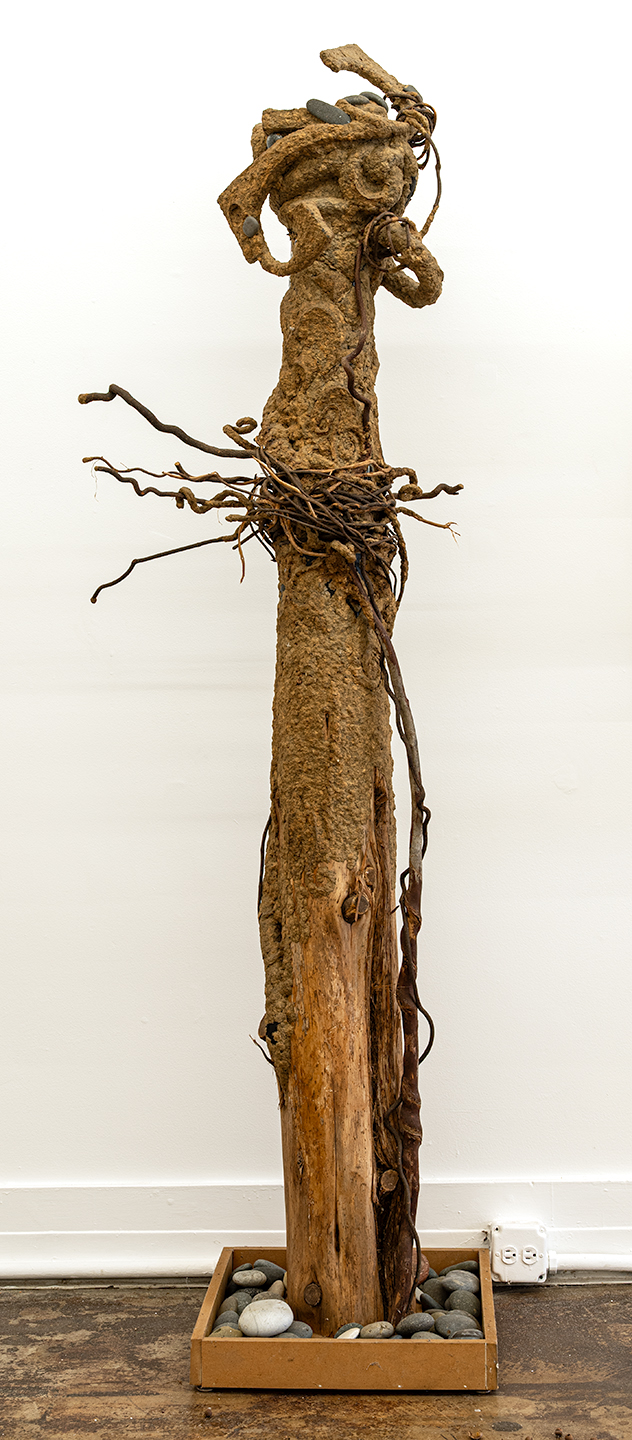
Brian Rust’s favorite piece from Parallel Vessels is pictured here.
Untitled, (large column), c.2000, papier mache, paint, found objects, 90h x 30w x 22d in.
“On seeing this column-based sculpture in Kath’s studio, I was first struck by its simplicity and rich earthen tones. It is totemic and mainly symetrical with slight variations. The longer I look, the more details I find that make it richer and more complex. The base starts as a cedar trunk and ends as an architectural column and capital. The paper-pulp surface is full of subtle undulations and forms . I read these elements as a mediation between nature and human-made world, about both stability and sense of change.”