
The beat is simple – four on the floor – and the grooves repetitive, often stretching well past the 30-minute mark. But nothing else about Fela Kuti’s music feels easy. Drums weave in and out of the deceptively standard backbeat. Instrumental focus advances and retreats, responding to some invisible backbeat. It is infectious, energizing, and engaging.
It’s also the sound of a revolution.
Initially, the figures, much less the narrative, are difficult to discern. The intentionally monochromatic palette does little to help, offering the eye few clues as to when one line ends and other begins. It’s a painting that requires – and rewards – uninterrupted concentration and consideration. But for those that buy the ticket the rewards, such as they may be, are profound. Figures, twisted by pain, fear, and violence come into focus as Picasso’s massive masterpiece ‘Guernica’ recounts not only events, but the emotional toll – profound and tragic – that war demands.
It’s what the human condition looks like.
It begins with almost a whisper. Single piano keys pick out the simplest of progressions, joined after a few measures by softly plucked bass and a wistful voice. There’s a certain sweetness to it, despite darker themes of the price paid for unhinged Saturday nights. But when Vaclav Havel dropped the needle on the Velvet Underground’s ‘Velvet Underground and Nico’ album, he didn’t hear the decadence of New York, a city halfway around the world from his Czechoslovakian home. What he heard was music that sounded alien and experimental. He heard songs that chose, in their own way, to educate more than elevate. Those songs became part of the soundtrack for the Czech cultural and political moment known as the Velvet Revolution.
It’s what change sounds like.
Often, we see, understand, and gauge creative work based on its aesthetic appeal. A deeper dive might reveal metaphor and symbolism – ideas to be communicated. But even that can shortchange the power – the necessity – of art or music or theater. Because when art, specific and special, really resonates, it’s able to do something far more meaningful than decorate a wall or create conversation. It can engender change – real and meaningful. The late Fela Kuti is remembered as a musician, but also a revolutionary leader that challenged and changed culture in his native Nigeria. ‘Guernica’ became not only the marquee moment in Picasso’s illustrious career, but also a very real and substantive flag to wave in the face of fascism. The Velvet Revolution elevated not only Vaclav Havel, but his entire country and served as the first steps toward a democratic state. Art is important. Art can mean something. Art allows the artist to say things that are complicated, controversial, or difficult.
Art is mandatory. It’s what the future feels like.
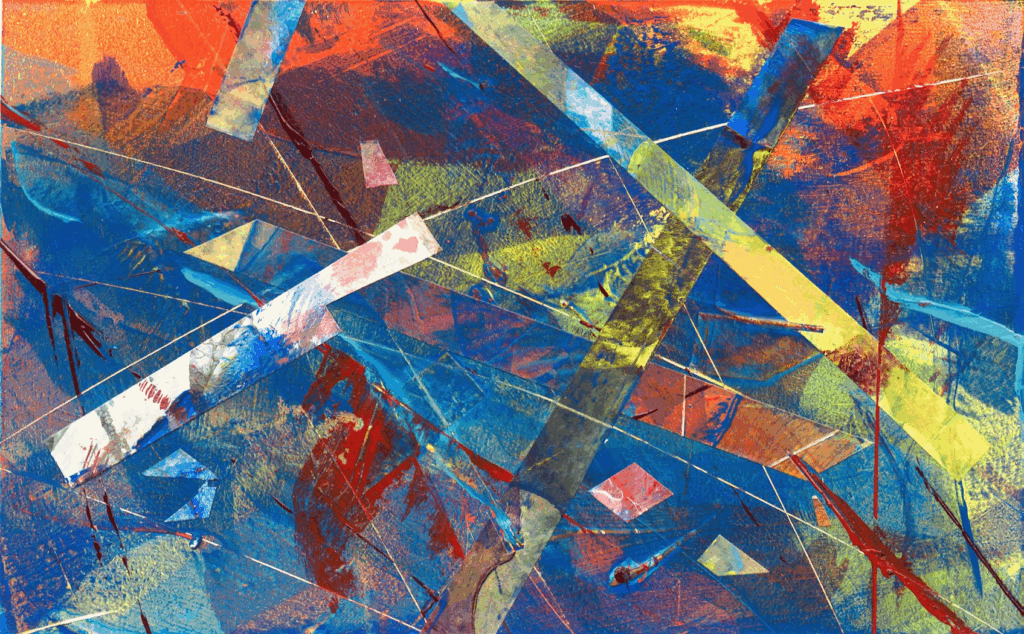
SHIPWRECK XLIV, 2025, acrylic on paper, by Sam Harris